Mighty Mule Gate Repair in San Francisco: A Homeowner’s Guide
Mighty Mule gate opener repair in San Francisco typically runs $180–$380 for common issues like battery replacement, control board moisture damage, or actuator arm binding. Most repairs are diagnosable in under 30 minutes if you know what to look for. If you’d rather not troubleshoot yourself, call us at (866) 426-1530 for a free estimate.
Here’s the mistake we see most often: a homeowner in the Richmond District cranks the force adjustment screw all the way up because their gate “stopped working,” then calls us six months later when the motor burns out. The real problem was a dragging hinge the whole time. The Mighty Mule’s auto-reverse system isn’t broken — it’s doing exactly what it’s designed to do, and overriding it destroys the unit faster.
We’ve been repairing Mighty Mule, LiftMaster, FAAC, and Elite systems across San Francisco for 17 years. Carlos Estrada, our owner and service manager, has personally diagnosed hundreds of these units. This guide covers what actually fails, why San Francisco’s climate makes certain problems worse, and when you’re better off replacing than repairing.
How Mighty Mule’s Actuator Arm Design Creates Unique Failure Modes
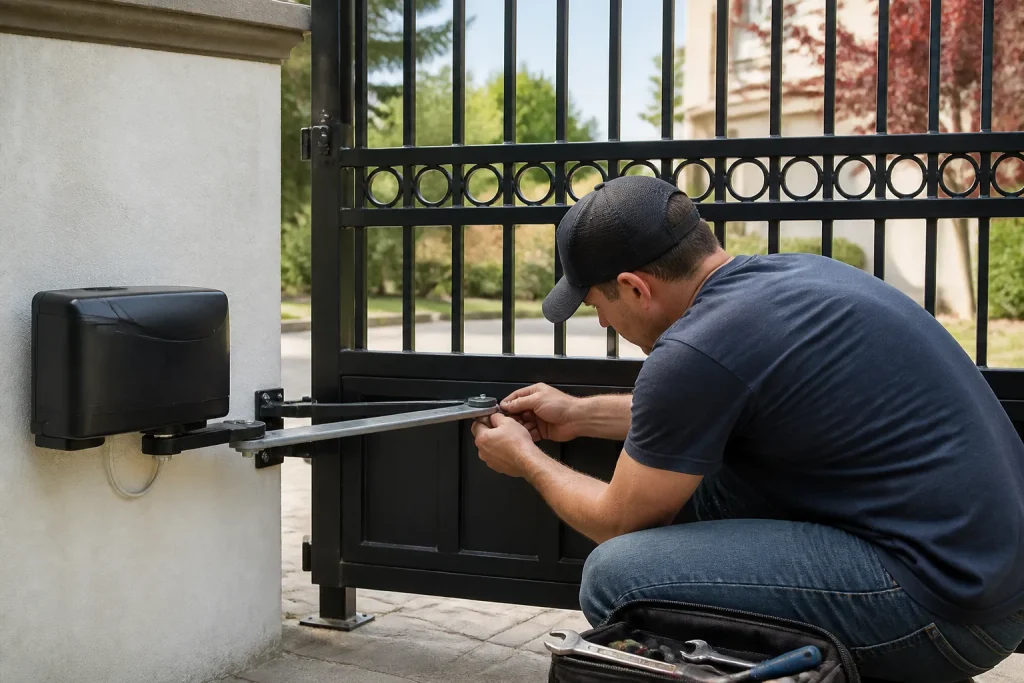
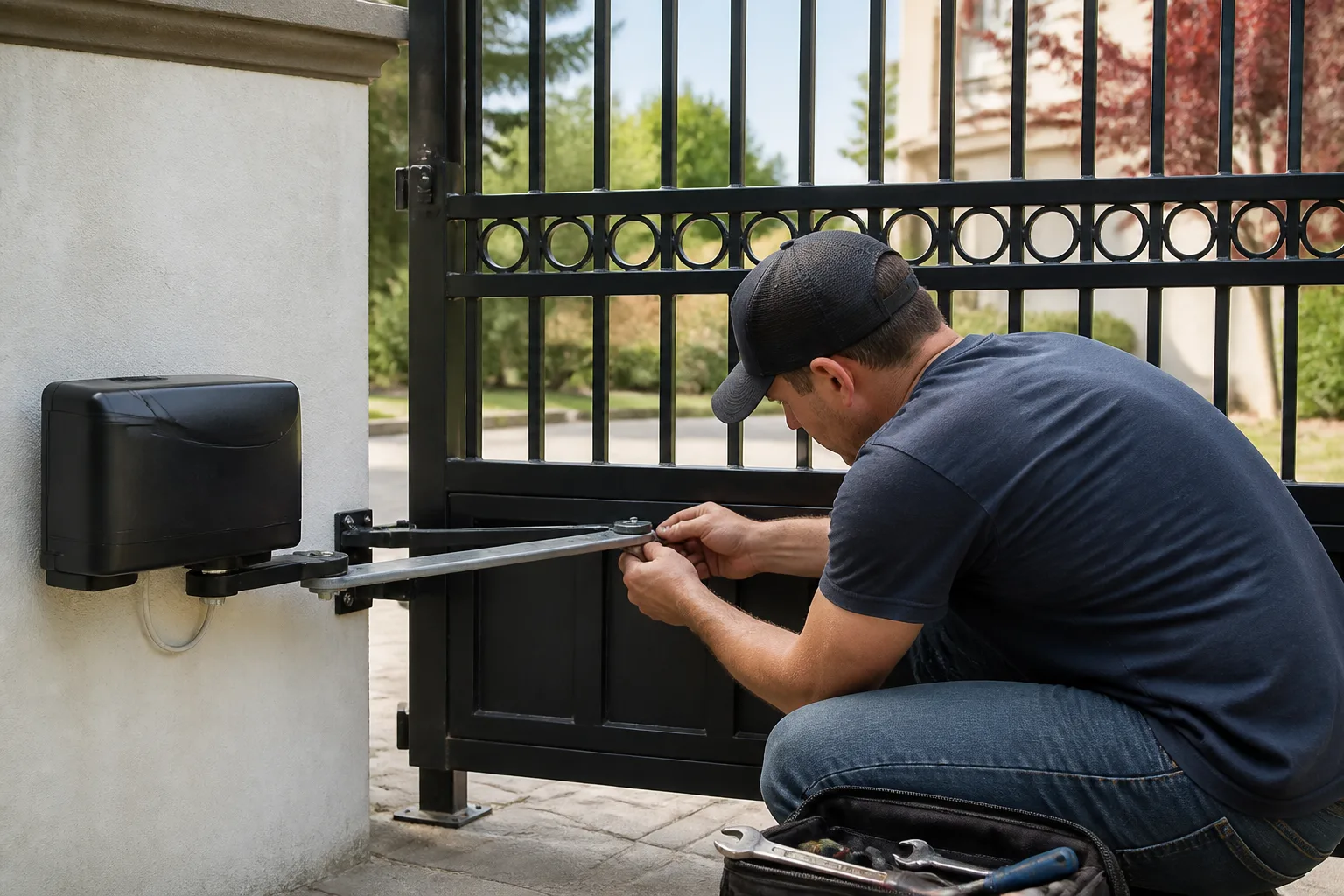
Most gate openers use a ram-style linear actuator — a straight push-pull cylinder. Mighty Mule uses a pivoting articulated arm that swings in an arc. This design keeps the motor compact and affordable, but it introduces binding points that ram-style operators don’t have.
The arm connects to the gate through a single pivot joint. When that joint seizes or the mounting bracket loosens, the motor detects excess resistance and triggers the auto-reverse. In our experience, about 40% of “dead” Mighty Mules in San Francisco are actually fine — the arm just can’t move freely through its arc.
Here’s what to check:
- Disconnect power and try moving the gate by hand. It should swing smoothly through its full range. Any catching or grinding means mechanical drag, not motor failure.
- Inspect the actuator arm pivot for rust or debris buildup. The Outer Sunset’s salt air accelerates corrosion here.
- Check that the mounting bracket hasn’t worked loose from the gate post. Wood posts in older San Francisco homes (think Noe Valley or the Mission) soften over decades and let bolts wiggle free.
- Look for bent arm segments. A backing vehicle, falling branch, or even a heavy vine can distort the geometry enough to cause binding.
We pulled one out of a garage over in the Sunset last month where the homeowner had been “fixing” the auto-reverse by cycling the opener repeatedly until it forced through. The arm was bent 15 degrees and the motor gearbox had stripped its nylon gears. A $40 hinge adjustment had become a $340 motor replacement.
When the mechanical path is clear and the arm still won’t complete its cycle, the issue usually moves to electrical components.
San Francisco’s Solar Battery Problem: Why Your Mighty Mule Dies in Fog
Mighty Mule markets heavily to solar-powered installations. In Arizona, this works great. In San Francisco’s fog belt, it’s a different story.
The stock 12V battery needs consistent charging to maintain cycle capacity. Solar panels rated for full sun deliver roughly 20–30% of their rated output under typical Outer Sunset or Parkside overcast conditions. We’ve measured trickle charge rates as low as 0.3 amps on foggy days — barely enough to offset the control board’s idle draw, let alone power multiple gate cycles.
Symptoms look like battery failure but aren’t:
- Gate works fine mid-day then fails evening or morning
- Intermittent operation that “fixes itself” after sunny weather
- Control board beeping low-battery warning even with a new battery installed
Real solutions for San Francisco properties:
- Upgrade panel wattage — double the factory spec minimum if you’re west of 19th Avenue or north of Golden Gate Park where fog lingers.
- Add AC trickle charging — run low-voltage landscape wire to a 120V transformer. This isn’t “defeating” solar; it’s supplementing it for a climate the factory didn’t design for.
- Replace the battery every 2–3 years proactively — even “good” batteries lose capacity in cooler temperatures, and San Francisco’s 50–60°F average means less available amperage than the same battery in warmer climates.
We keep fresh batteries and upgraded solar panels in stock because this is such a common call. Carlos and his team can usually convert a failing solar setup to hybrid AC/solar in about 90 minutes.
The Force Adjustment Trap: When Tightening the Screw Destroys Your Motor
Mighty Mule openers have a force limit adjustment screw on the control board housing. It’s meant for fine-tuning after installation — compensating for slight gate weight variation or wind resistance. It’s not a repair tool.
When a gate starts reversing unexpectedly, the correct response is finding and fixing the mechanical drag. The common wrong response is cranking that screw clockwise until the motor powers through. This does three bad things:
- Disables the safety auto-reverse, creating a crushing hazard
- Overloads the motor, shortening its lifespan by 50–70%
- Masks the underlying problem, which gets worse until something expensive breaks
Legitimate adjustment scenarios are narrow:
- New installation where the gate is slightly heavier than spec but mechanically sound
- Seasonal wind load changes (not typically an issue in San Francisco’s calm summers, but relevant for hillside properties in Pacific Heights or Twin Peaks)
- Minor settling of gate posts over the first year after installation
Our rule at Anchor Gate Repair San Francisco home: if the force screw needs more than a quarter-turn from factory position, there’s a mechanical problem. We find it and fix it. A properly maintained Mighty Mule should run near factory force settings for its entire service life.
Coastal Moisture and Control Board Failure: SF’s Signature Problem
San Francisco’s marine layer doesn’t just make mornings gray. It infiltrates outdoor electronics in ways that inland climates don’t replicate.
Mighty Mule control boards have a specific failure pattern we see almost exclusively within two miles of the Pacific. Moisture wicks through the plastic housing seams or the wire entry grommets, condenses on the circuit board, and creates intermittent shorts. This presents very differently from a dead battery:
| Dead Battery | Moisture-Damaged Board |
|---|---|
| Consistent failure to operate | Random operation, works then doesn’t |
| No LED activity | LED flickers or shows wrong code |
| Beeping low-battery warning | No beep pattern matches manual |
| Fixed by battery replacement | Temporary improvement, then returns |
The moisture damage is often visible if you open the housing — white or green corrosion on the board traces, particularly near the transformer and relay solder points. But by the time it’s visible, the board is usually beyond economical repair.
Prevention matters more than repair here. We recommend:
- Installing the control box with the wire entry points facing down, never up
- Adding a bead of silicone around the housing seam during installation (factory sealant degrades after 3–4 years)
- Placing the box under eave overhang where possible — even 12 inches of roof protection cuts moisture exposure dramatically
For properties in the Sunset, Richmond, or Marina where fog is heaviest, we sometimes relocate the control box to a garage interior wall and run low-voltage cable to the gate. It’s a $120–$180 modification that can add years to the electronics.
When Repair Stops Making Sense: The Upgrade Decision Point
We’re honest about this because we’re not in the business of collecting repeat service calls on dying equipment. Mighty Mule builds to a price point. The arm design, the plastic gearing, the basic control board — they’re engineered for 5–7 years of residential light use under favorable conditions.
In San Francisco, with our moisture, our hills, our older gates with imperfect alignment, that realistic lifespan often compresses to 4–6 years. We’ve repaired 8-year-old Mighty Mules that were genuinely at end-of-life, and we’ve told owners of 3-year-old units with chronic problems that replacement is the smarter money.
Repair makes sense when:
- The unit is under 5 years old and the failure is isolated (one component, clear cause)
- The gate itself is in good mechanical condition
- You’re in a rental or short-term ownership situation
Upgrade to a mid-grade operator (LiftMaster’s CSW line, FAAC’s 400 series, or comparable) when:
- You’re on your third repair in two years
- The gate has structural issues that stress any opener (we can weld and fabricate fixes for those — see our Gate Repair in San Francisco page)
- You’re running a multi-family property or commercial access point where downtime costs more than equipment
- You need features Mighty Mule doesn’t offer: telephone entry integration, loop detectors, or battery backup robust enough for daily cycling
We install and service across all these brands, so our recommendation isn’t tied to what we sell. Carlos makes the call based on what the gate actually needs.
When to Call a Pro for Mighty Mule Repair in San Francisco
Some fixes are genuinely DIY-friendly: battery swap, remote reprogramming, clearing debris from the arm path. Others need specialized knowledge or tools.
Call (866) 426-1530 when you’re dealing with:
- Control board diagnostics or replacement
- Actuator arm binding you can’t source to a visible cause
- Electrical issues beyond the battery (solar panel output testing, AC conversion)
- Any safety system override — if you’ve touched that force screw, we need to inspect the full mechanical path
- Structural gate problems: sagging, post rot, hinge weld failure
We carry Mighty Mule parts, but we also stock cross-compatible components and can fabricate brackets or linkage when factory parts are backordered. Our Gate Motor & Opener in San Francisco service covers everything from diagnosis through full replacement.
Related services in San Francisco: If your gate needs more than opener work, we also handle Gate Installation in San Francisco and structural repairs through our in-house welding shop.
The Bottom Line
Mighty Mule openers are repairable, but they’re frequently misdiagnosed because their design quirks — the articulated arm, the force-sensitive auto-reverse, the solar dependency — don’t behave like premium operators. San Francisco’s fog and moisture add failure modes the factory manual doesn’t address.
Key takeaways:
- Auto-reverse is a feature, not a bug — don’t override it
- Solar panels underperform in fog; plan for supplemental charging
- Moisture damage looks random and intermittent, not like simple battery failure
- There’s a honest upgrade point where repair becomes throwing good money after bad
- Mechanical gate condition matters more than opener brand — we fix both
If you’re in San Francisco and your Mighty Mule is acting up, Anchor Gate Repair San Francisco offers free estimates. We’ll tell you what’s actually wrong, what it’ll cost to fix, and whether fixing makes sense. No charge to find out. Call (866) 426-1530 or reach out through our site.
Frequently Asked Questions
Most repairs fall between $180 and $380, depending on whether it’s a battery replacement, control board issue, or actuator arm rebuild. Motor replacement runs higher, usually $450–$680 installed. We don’t quote without seeing the unit, but estimates are free — call (866) 426-1530 to schedule.
Intermittent operation usually means either a dying battery with inconsistent charge retention, or moisture infiltration of the control board creating random shorts. In San Francisco’s coastal neighborhoods, moisture damage is more common than the online forums suggest. A multimeter test on the battery under load and a visual board inspection will separate the two.
You can, but you shouldn’t. The force limit is a safety feature required by UL standards. Cranking it up masks mechanical problems and creates a crushing hazard. If your gate won’t close against normal resistance, the hinge, track, or gate alignment needs attention — not more motor force. We check mechanical drag as part of every service call.
Units under 5 years old with isolated failures are usually worth repairing. Beyond 7 years, or with multiple component failures, replacement typically costs less over a 3-year horizon. We stock mid-grade operators from LiftMaster and FAAC that outlast Mighty Mule’s service life without reaching commercial pricing. We’ll give you both numbers and let you decide.
Written by Carlos Estrada, Owner & Service Manager at Anchor Gate Repair San Francisco, serving San Francisco since 2009.
Need Gate Repair Help?
Call Anchor Gate Repair San Francisco — licensed & insured, available 24/7 in San Francisco.
(866) 426-1530