Linear Gate Repair in San Francisco: A Homeowner’s Guide
Linear gate repair in San Francisco typically costs between $180 and $450 depending on whether you’re dealing with a control board issue, motor replacement, or loop detector failure. Most Linear operators can be repaired rather than replaced, especially the legacy OSCO and ACP series still common throughout the city. If you’d rather not troubleshoot this yourself, call us at (866) 426-1530 for a free estimate.
Linear operators are often called “bulletproof” by installers. That’s exactly why homeowners in San Francisco are blindsided when they fail in ways that look nothing like a typical gate opener problem. We’ve spent 17 years working on gates across the city, and we’ve learned that Linear’s reputation for simplicity masks a specific set of failure points that most technicians misattribute to other causes. Here’s what actually goes wrong, why it happens, and how to get it fixed right the first time.
Why Linear Gate Operators Are Still Everywhere in San Francisco
Walk through any residential courtyard in the Richmond, Sunset, or Bernal Heights neighborhoods and you’ll spot Linear operators that have been running since the early 2000s. The legacy OSCO and ACP series were built with serviceable components, replaceable control boards, and straightforward wiring that made them favorites among San Francisco’s gate installers during the city’s building boom years.
Here’s what competitors miss: parts availability for these older Linear units is actually excellent. Unlike some brands that orphan their legacy lines, Linear maintained backwards compatibility on many components. The OSCO 3100 series control boards, ACP timing belts, and even early-generation limit switches remain obtainable through authorized distributors. This means repair is nearly always cost-effective compared to full replacement.
We regularly service Linear operators in Gate Repair in San Francisco properties that other companies have condemned as “too old.” Last month in the Outer Mission, a property manager was quoted $2,800 for a complete gate replacement. Carlos and his team replaced a failed transformer and recalibrated the limit switches for under $400. The unit’s still running fine.
The key is finding a technician who knows the difference between a genuinely failed operator and one that’s been misdiagnosed. That’s where 17 years of gate-only experience matters.
The Most Misdiagnosed Linear Failure: The Internal Transformer
This is the one that wastes the most money in San Francisco. A Linear gate that opens intermittently, responds to the remote only sometimes, or works fine in the morning and fails by afternoon is almost always blamed on:
- Weak remote batteries
- RF interference from nearby WiFi or cell towers
- A failing receiver
In our experience, it’s usually none of these. It’s the internal transformer and power supply board.
Linear’s transformer architecture runs hotter than comparable LiftMaster or FAAC units. Over years of cycling, especially in San Francisco’s fog-cooled, salt-air environment, the transformer windings degrade and voltage regulation becomes unstable. The board receives enough power to function partially, but not consistently. This presents exactly like a remote or receiver problem.
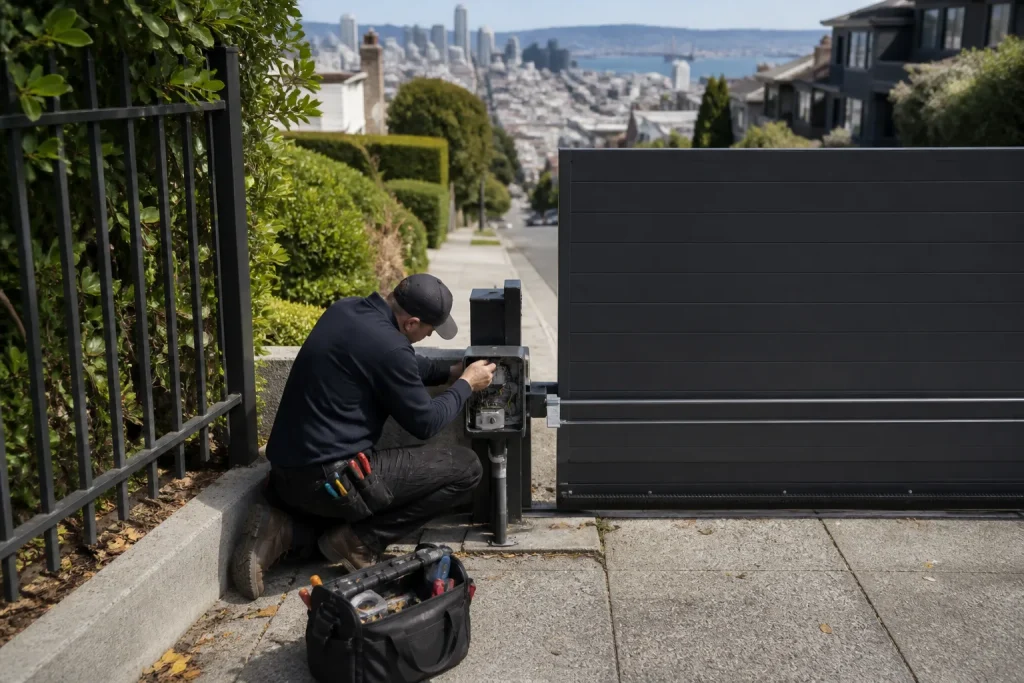
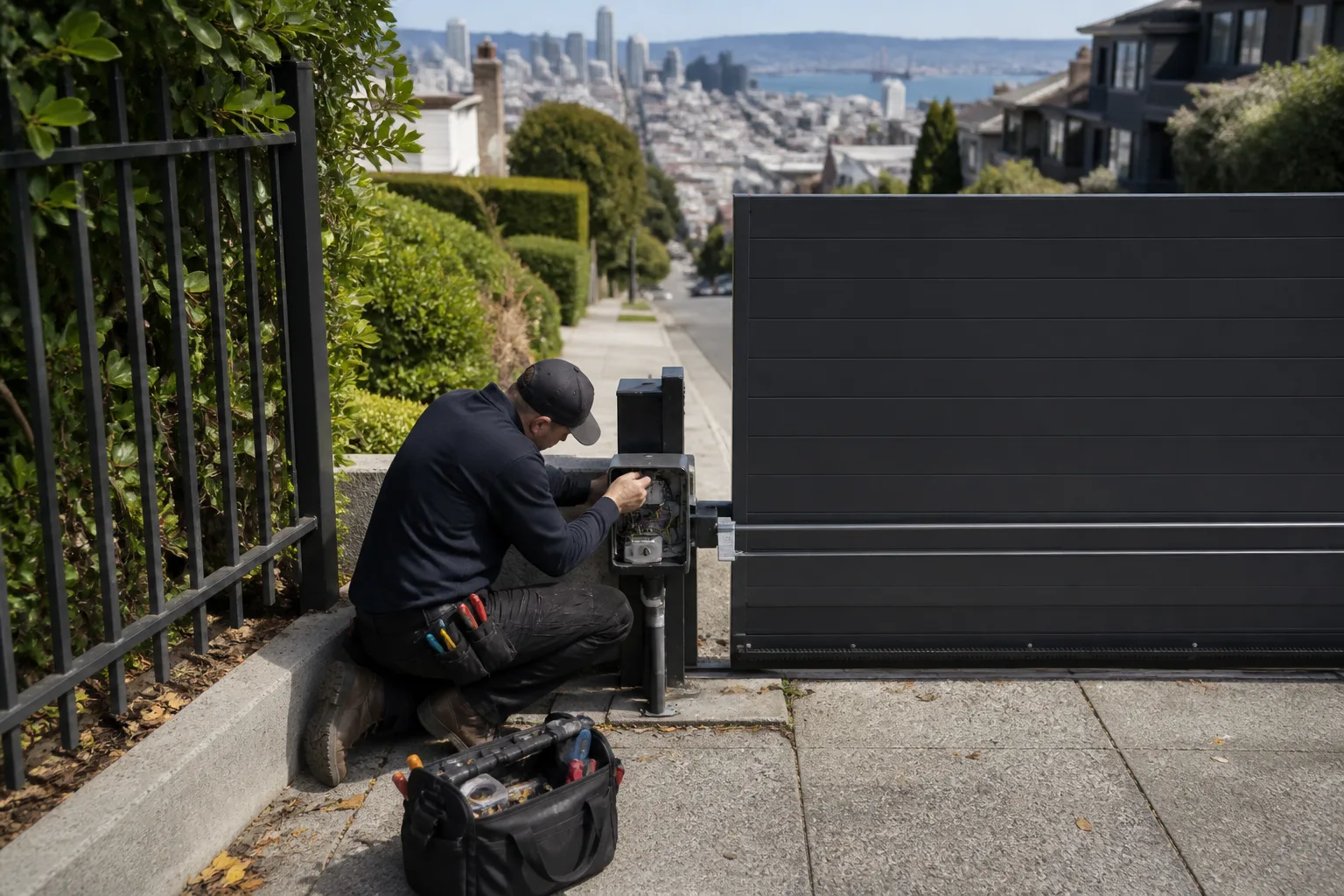
We’ve seen technicians replace three remotes, two receivers, and even install RF repeaters before catching the actual issue. The voltage test takes 30 seconds with a multimeter. The transformer replacement takes about 45 minutes. Total cost should run $220-$340, not the $800+ some homeowners spend chasing phantom signal problems.
If your Linear gate has intermittent symptoms that seem to worsen as the day progresses, ask your technician to check transformer output voltage under load before replacing anything else.
Underground Loop Detectors: San Francisco’s Hidden Weak Point
Linear’s loop detector integration differs from other brands in one critical way: their detectors are more sensitive to inductance drift, which means they fail faster when the loop wire itself degrades. In San Francisco, this is a bigger problem than installers estimate.
Here’s why. Most residential driveway loops in the city are installed under concrete or asphalt with minimal conduit protection. Our clay-heavy soils in neighborhoods like Noe Valley and Potrero Hill shift with seasonal moisture. The freeze-thaw cycles we do get, combined with constant vehicle loading, fatigue the loop wire at the saw-cut joints. Water infiltration accelerates this, especially in the Sunset where drainage is historically poor.
When a loop fails, Linear detectors tend to throw ambiguous error codes or simply stop responding. Technicians unfamiliar with the brand often replace the detector board first, then the operator, before finally discovering the buried loop is open-circuited.
We test loops directly with a handheld inductance meter before touching any above-ground equipment. If the loop’s failed, we have two options: re-cut and re-bury a new loop, or install an above-ground proximity sensor as an alternative. In San Francisco’s tight spaces and concrete-heavy driveways, the sensor option often saves $600-$1,200 in concrete work.
Carlos and his team have done this conversion on dozens of properties from the Marina down to Bayview. It’s not always the right choice, but it’s worth knowing you have options.
Access Control Quirks: Phantom Open/Close Cycles
Linear operators integrate with telephone entry systems, keypads, and card readers more commonly than most brands in San Francisco’s multi-unit buildings. This integration is powerful but has specific programming quirks that cause phantom open/close cycles, especially in older installations.
The most common trigger: momentary vs. maintained contact settings in the access control relay. Linear operators default to expecting a specific pulse duration from external devices. When a BFT or Mighty Mule keypad gets swapped in during a retrofit, or when a telephone entry system ages and its relay contacts start bouncing, the Linear board interprets the noise as repeated open commands.
We’ve been called to buildings in the Tenderloin and South of Market where the gate was “opening by itself at 3 AM.” The access log showed nothing. The problem was a failing relay in a 15-year-old entry system sending microsecond contact bounces that the Linear operator faithfully executed.
Fixing this requires understanding both the operator and the access control device. We carry test keypads and temporary entry systems to isolate whether the problem is above or below the operator. This diagnostic approach, learned over 17 years, prevents the expensive guessing that happens when a company knows gates but not access control, or access control but not Linear specifically.
Our Gate Motor & Opener in San Francisco service includes full access control troubleshooting for exactly this reason.
What to Bring to Your Service Call
The fastest, cheapest Linear repair happens when you come prepared. Here’s what cuts diagnosis time and cost:
- Model number and serial tag. On most Linear operators, this is on a metal plate inside the main housing. A photo on your phone is fine. The model tells us which control board revision, which transformer spec, and which diagnostic codes apply.
- Failure pattern description. “It doesn’t work” is less useful than “It opens fine but won’t close unless I hold the button,” or “It stopped working after the rain last Tuesday.” Time-of-day patterns, weather correlations, and whether the problem is getting worse all point to specific components.
- Recent changes. New remote? New landscaping crew that might have hit the loop wire? Power outage last month? These details matter more than you’d think.
- Access to the property’s electrical panel. We sometimes need to verify dedicated circuit integrity, especially in older San Francisco buildings with original wiring.
With this information, most Linear diagnoses take under 20 minutes. Without it, we’re hunting in the dark, and you’re paying for that time.
When to Call a Pro vs. When to Wait
You can safely check a few things yourself: remote batteries, visible obstructions in the gate track, and whether the manual release works smoothly. Beyond that, Linear operators carry lethal voltage internally, and the torsion or tension springs on sliding and swing gates store significant mechanical energy. We’ve seen homeowners in San Francisco injure themselves on what looked like simple adjustments.
If your operator is humming but not moving, if you’re seeing any burning smell from the housing, or if the gate reverses unpredictably, stop using it and call. These are signs of electrical or mechanical failure that won’t improve and may damage other components if forced.
Related services in San Francisco: If you’re considering whether repair or replacement makes more sense, our Gate Installation in San Francisco page covers what new operators cost and when they’re worth it.
Key Takeaways
- Linear’s legacy OSCO and ACP series are still highly repairable, with good parts availability
- Intermittent operation is usually the internal transformer, not remote or receiver issues
- Underground loop detectors fail faster in San Francisco’s shifting soils and concrete driveways
- Phantom open/close cycles typically trace to access control relay problems, not operator failure
- Having your model number, serial tag, and failure pattern ready speeds repair and reduces cost
The Bottom Line
Linear gate operators earned their reputation for durability, but that same reputation means failures get misdiagnosed by technicians who assume the problem must be something else. In San Francisco’s specific environment, salt air, soil movement, and decades-old access control integrations create failure patterns that look unfamiliar if you haven’t worked on hundreds of these units.
We’ve been the call after other companies have given up, replaced the wrong parts, or recommended unnecessary replacements. Carlos and his team approach every Linear job with the specific knowledge of what these operators do, where they fail, and how to fix them efficiently. 304 customers reviewed us, and the pattern we hear most is some version of “you figured out what two other companies couldn’t.”
If you’re in San Francisco and your Linear gate isn’t behaving right, Anchor Gate Repair San Francisco home offers free estimates. Call (866) 426-1530 and tell us what you’re seeing. We’ll tell you honestly whether it’s a quick fix, a parts replacement, or time to consider other options.
Frequently Asked Questions
Most Linear repairs in San Francisco run between $180 and $450. Simple fixes like transformer replacement or limit switch adjustment typically fall at the lower end. Control board replacement, motor rebuilds, or loop detector work run higher. We don’t quote over the phone without details, but estimates are always free. Call (866) 426-1530 to describe what you’re seeing and we’ll give you an honest range.
For Linear’s OSCO and ACP series, repair is almost always cheaper. These units were built to be serviced, parts remain available, and a typical repair costs 20-40% of full replacement. We recommend replacement only when the operator has suffered multiple component failures, severe corrosion, or when you need features like smartphone connectivity that older units can’t support. Carlos evaluates this honestly on every call, we’ve turned down replacement jobs that didn’t need them.
Intermittent operation in Linear operators is most commonly the internal transformer and power supply board failing under load, not remote batteries or signal interference. The transformer outputs enough voltage when cold but degrades as it warms, causing afternoon or evening failures after morning success. A 30-second voltage test confirms this. Don’t replace remotes or receivers until this is ruled out.
Yes. We work on the brand you already have, and that includes the full ecosystem around it. Phantom open/close cycles, keypad programming errors, and telephone entry system miscommunication are common issues we resolve. Our 17 years of gate-only experience includes both the mechanical operator and the electronic access control that drives it, something generalist electricians or handymen rarely match.
Written by Carlos Estrada, Owner & Service Manager at Anchor Gate Repair San Francisco, serving San Francisco since 2009.
Need Gate Repair Help?
Call Anchor Gate Repair San Francisco — licensed & insured, available 24/7 in San Francisco.
(866) 426-1530