
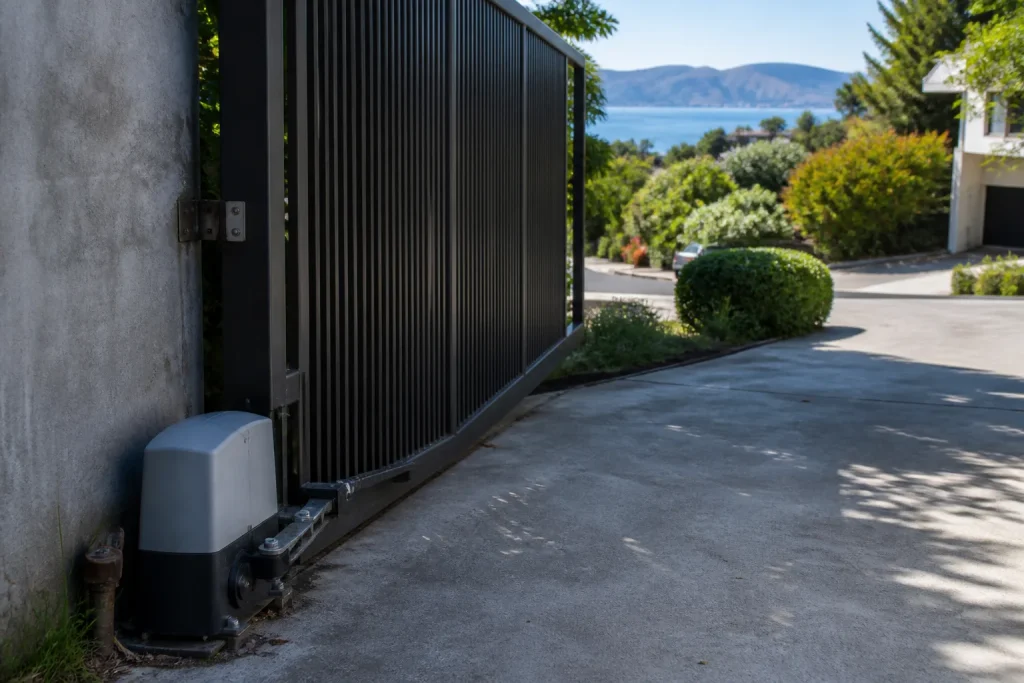
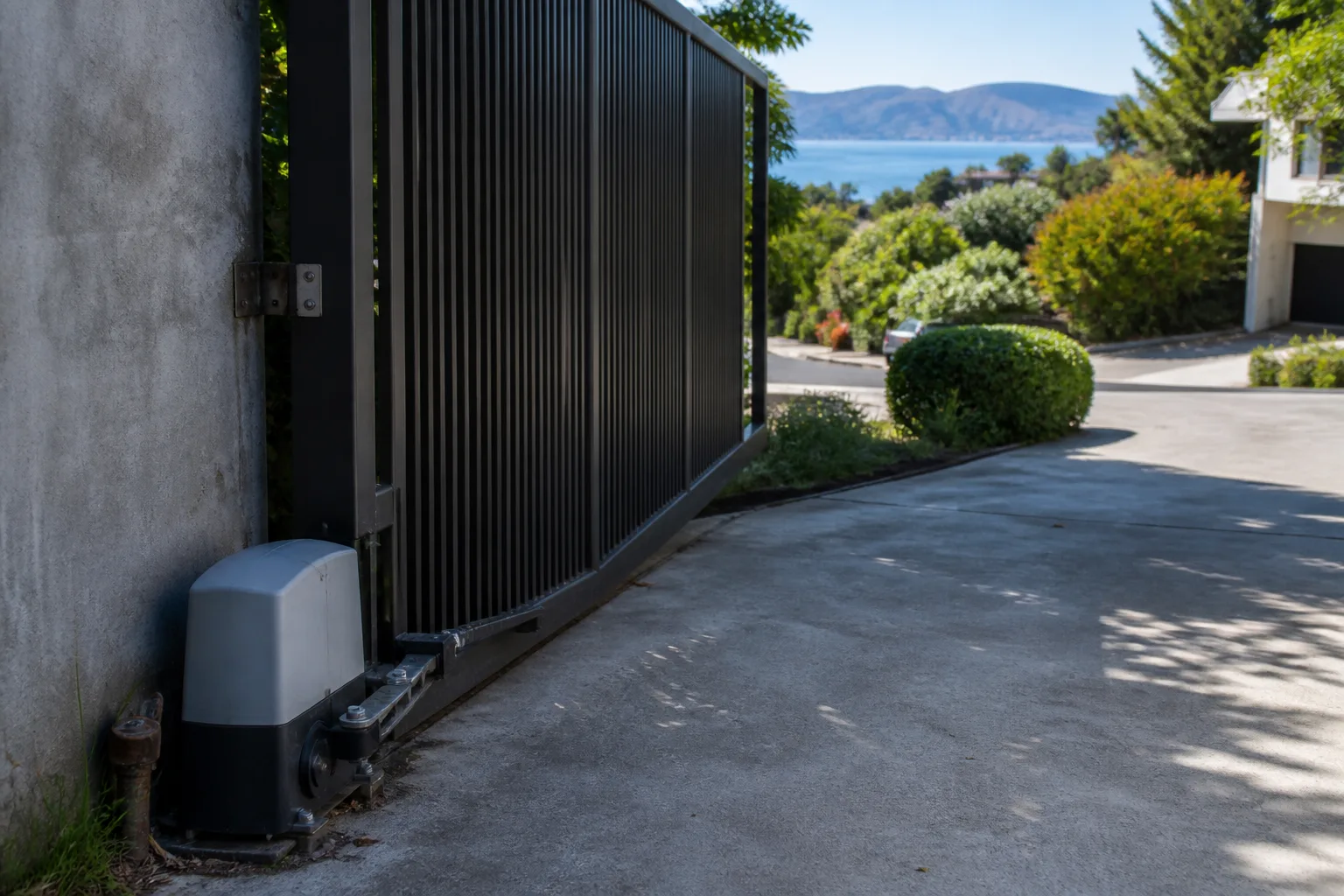
Gate Motor & Opener: Repair or Replace? How San Francisco Homeowners Decide
Most gate motors in San Francisco can be repaired if the failure involves a logic board, limit switch, or capacitor, typically costing 40-60% less than replacement. Replacement makes more sense when the motor has suffered water damage to the gearbox, repeated circuit board failures, or when it’s undersized for the gate’s actual load, a common problem on San Francisco’s hillside properties. If you’d rather not diagnose this yourself, call us at (866) 426-1530 for a free, no-pressure estimate.
A five-year-old LiftMaster on a foggy Richmond District property can be more worn out than a twelve-year-old unit in Bernal Heights — and most technicians won’t tell you why. We’ve pulled motors out of garages in the Outer Sunset that looked like they’d been submarine-tested, while identical models from dry Portola Hill lots ran smooth with nothing but routine grease. The repair-or-replace question isn’t about age or sticker price. It’s about where you live in San Francisco, what actually failed, and whether the root cause got fixed or just the symptom.
How San Francisco’s Microclimates Destroy Motors at Different Speeds
San Francisco’s weather isn’t uniform, and your gate motor’s lifespan depends heavily on which fog belt you occupy.
The Outer Richmond, Outer Sunset, and Parkside sit in what we call the heavy corrosion zone. Summer fog rolls in thick, salt air penetrates motor housings, and condensation builds inside control boxes that were never designed for perpetual damp. We’ve opened FAAC units in the Sunset where the circuit board traces had literally dissolved from electrolytic corrosion. A motor that might last fifteen years in Walnut Creek dies in six here. If you’re in these neighborhoods, replacement often becomes the smarter long-term play because the environment will keep attacking repaired components.
Bernal Heights, Noe Valley, Potrero Hill, and the Mission sit in rain-shadow zones with significantly drier conditions. Motors here typically age from mechanical wear, not environmental attack. That means repairable failures — worn limit switches, tired capacitors, degraded drive gears — dominate. We’ve rebuilt Linear operators in Bernal Heights that were fourteen years old and had another solid decade ahead after a $220 parts swap.
The Marina and Embarcadero add their own twist: salt spray carried on wind off the bay, but combined with newer construction and better-drained lots. Motors here fail faster than inland, but not as catastrophically as the far west side.
Key takeaway: Ask your technician where they’ve worked recently in San Francisco. Someone who treats the city as one climate zone is guessing.
Three Failures Worth Repairing Every Time
After seventeen years of gate-only work in San Francisco, we’ve seen enough patterns to get confident about which diagnoses mean “fix it” and which mean “walk away.”
1. Logic board replacement
Power surges, lightning strikes on nearby transformers, or simply age-related capacitor leakage on the board itself — these kill control brains while the motor and gearbox stay healthy. A new board from the manufacturer, properly programmed, typically runs $180-$340 installed depending on brand. Viking and Ghost Controls boards tend toward the lower end; BFT and FAAC run higher due to programming complexity. We’ve done hundreds of these. The motor itself doesn’t care that its brain got swapped.
2. Limit switch failure
These mechanical or magnetic sensors tell the motor when to stop opening or closing. They wear out, get knocked out of alignment, or fill with debris. Replacement is usually under $150, and the motor has plenty of life left. We see this constantly on hillside gates in Twin Peaks and Diamond Heights where vibration works things loose over time.
3. Capacitor failure
The start capacitor gives your motor the kick it needs to overcome initial inertia. When it degrades, the motor hums but won’t turn, or strains and trips its thermal overload. Capacitors cost $40-$80 plus labor. It’s a twenty-minute fix on most brands. We’ve had customers in the Haight nearly get talked into full motor replacements for this.
When to call a pro: If your motor makes noise but doesn’t move, or moves erratically, don’t keep cycling it. That thermal overload won’t protect the gearbox from eventual damage. Call (866) 426-1530 and we’ll diagnose it properly.
Two Failures That Mean Replace, Not Repair
Some damage patterns in San Francisco gate motors are economic dead ends. We’ve learned to spot them quickly and explain why to customers without the runaround.
1. Water-damaged gearbox
When moisture gets past seals and into the worm drive or reduction gears, it creates a slurry of metal particles and old grease that destroys everything it touches. Rebuilding a gearbox costs nearly as much as a new motor, and the housing often has micro-cracks that let water back in. We see this on improperly sealed installations in the Sunset and Richmond, especially on older Mighty Mule units with less robust sealing. Replacement with proper weatherproofing is the only sensible path.
2. Repeated circuit board failures
If you’ve replaced the logic board once and it fails again within two years, the motor has a deeper problem — usually a failing transformer or rectifier that’s sending dirty power to the new board, or a ground fault that keeps finding the board’s weakest trace. Chasing this gets expensive fast. We’ve had to deliver this news to homeowners in Pacific Heights who’d already spent $600 on two previous “repairs” that never addressed the root cause. A new motor with modern surge protection and clean power architecture solves it permanently.
Related services in San Francisco: If you’re considering replacement, our Gate Motor & Opener in San Francisco page covers full installation options and brand guidance.
Why Hillside Gates in San Francisco Kill Motors Faster
This is the factor most technicians miss entirely, and it’s critical in a city built on hills.
A gate motor’s rated capacity assumes level installation with balanced gate weight. San Francisco’s steep lots — think Potrero Hill, Bernal Heights, Twin Peaks, the upper Castro — often have gates installed on grades that create persistent side-load on the operator. The motor works harder on every cycle. Hinge binding from frame racking adds drag the motor wasn’t specced for. We’ve measured current draw on hillside installations running 40% above nameplate rating.
Here’s what happens: the motor overheats, the thermal protection cycles more frequently, and the owner thinks they have a “bad motor.” They replace it. The new motor does the same thing in three years because nobody fixed the gate geometry.
Before any motor replacement on a San Francisco hillside property, we check:
- Gate plumb and level in both open and closed positions
- Hinge condition and pin wear
- Track or guide roller alignment for sliding gates
- Actual gate weight vs. motor rated capacity
We weld, fabricate, and repair on-site — so when we find a sagging frame or bent track, we fix it before the new motor goes in. That’s why our replacements last. Carlos and his team have learned that a motor is only as good as the gate it moves.
If your property is on a grade and you’ve been through multiple motors, the motor isn’t the problem. We offer free estimates to assess the full system — call (866) 426-1530.
How to Read a Repair Estimate: Confidence vs. Guesswork
Not every technician who shows up in San Francisco knows gate motors specifically. General handymen and even some garage door companies will take a stab, but gate operators are a different animal with their own diagnostic protocols.
A confident diagnosis sounds specific: “The limit switch arm is worn at the cam profile, so it’s not consistently triggering. That’s a $140 repair with a thirty-minute calibration after.” A guess dressed up as expertise sounds vague: “Probably the board or something electrical. We’ll replace a few parts and see if that fixes it.”
Here’s what we think a solid estimate should include:
- Exact failure mode identified through testing, not assumption
- Specific part numbers and manufacturer sourcing
- Labor separated from parts
- Explanation of why related components aren’t suspect
- Clear distinction between repair and replacement scenarios
We work on the brand you already have — LiftMaster, FAAC, BFT, Linear, Viking, Ghost Controls, DoorKing, Elite, Mighty Mule — so we don’t need to “see what we can find.” We know what’s in stock, what ships from where, and what discontinued boards have compatible substitutes. Seventeen years of gate-only experience means we’ve seen your exact failure before, probably on your exact model.
304 customers reviewed us — here’s what they said. That 4.8-star average reflects jobs where we told people to repair when it made sense, and replacement when it didn’t. Carlos Estrada is Owner and Service Manager, personally accountable for every diagnosis his team makes.
The Bottom Line
Repair your San Francisco gate motor when the failure is isolated to a logic board, limit switch, or capacitor, and when your property’s environmental conditions won’t just recreate the problem. Replace it when the gearbox is compromised, when previous repairs have failed repeatedly, or when the motor was never properly specced for your gate’s actual load and installation conditions.
The cheapest repair is the one that lasts. The most expensive replacement is the one that fails again because nobody fixed why the first motor died. We’ve been doing this in San Francisco since 2009, and we’ve learned that the fog, the hills, and the salt air all write their own rules.
If you’re in San Francisco and not sure which category your gate falls into, Anchor Gate Repair San Francisco home is where to start. We offer free estimates with real diagnostics, not sales pitches. Call (866) 426-1530 and we’ll give you a straight answer on repair vs. replacement.
Frequently Asked Questions
Most common repairs run $140-$380 depending on the part and brand. Logic boards for Viking or Ghost Controls typically fall at the lower end; BFT and FAAC boards run higher due to European programming requirements. Capacitor and limit switch repairs usually stay under $200 total. Call (866) 426-1530 for an exact quote on your specific model — estimates are free.
Repair is cheaper when the failure is limited to one replaceable component. A $220 board swap beats a $1,400-$2,200 motor replacement. But if the motor has suffered gearbox damage or multiple previous failures, replacement becomes the more economical long-term choice. We evaluate this on every call and tell you honestly which path saves money. Call (866) 426-1530 for a free assessment.
We service nine major brands: LiftMaster, FAAC, BFT, Linear, Viking, Ghost Controls, DoorKing, Elite, and Mighty Mule. That covers the vast majority of residential and light commercial installations in San Francisco. We work on the brand you already have, so you rarely need a second company. For full installation options, see our Gate Installation in San Francisco page.
In dry inland neighborhoods like Noe Valley or Bernal Heights, a properly installed motor typically lasts 12-15 years with basic maintenance. In heavy fog zones like the Outer Sunset or Richmond District, salt corrosion can cut that to 6-10 years unless the installation includes upgraded weatherproofing. Hillside installations with poor gate geometry can kill even a quality motor in under 5 years. The environment and installation quality matter more than the brand name.
Written by Carlos Estrada, Owner & Service Manager at Anchor Gate Repair San Francisco, serving San Francisco since 2009.
Need Gate Repair Help?
Call Anchor Gate Repair San Francisco — licensed & insured, available 24/7 in San Francisco.
(866) 426-1530