Gate Parts & Welding: Repair or Replace? How San Francisco Homeowners Decide
Most gate structural failures in San Francisco are repairable with proper welding and fabrication — replacement only becomes necessary when frame metal has thinned beyond safe weld penetration or when damage extends to multiple structural points simultaneously. The honest answer depends entirely on whether the person assessing your gate can actually fix steel, or is limited to swapping parts they stock. If you’d rather skip the guesswork, call us at (866) 426-1530 for a free structural evaluation.
Here’s the mistake we see constantly: a homeowner calls three companies for a sagging gate, gets three “replace it” quotes, and assumes that’s the truth. What they don’t know is that two of those companies don’t employ welders. Of course they’re going to recommend replacement — they literally can’t offer anything else. We’ve pulled jobs back from the brink in neighborhoods from Bayview to the Sunset where the “replace” diagnosis was really just a “we can’t weld” diagnosis wearing different clothes.
What’s Actually Fixable With In-House Welding
After 17 years of gate-only work in San Francisco, we’ve developed a clear hierarchy of structural failures. Some are straightforward repairs. Others are genuine end-of-life situations. The difference matters to your wallet and your security.
Typically repairable with welding and fabrication:
- Cracked hinge welds at the post or gate frame — the most common failure we see, especially on older wrought iron
- Bent or twisted steel frames from vehicle impact or ground shift
- Broken or corroded latch hardware, including strike plates and keeper assemblies
- Corroded post bases where the metal above grade is still sound
- Failed operator mounting brackets that have cracked from cycling stress
- Custom hinge or roller fabrication when OEM parts are discontinued
Genuine replacement indicators:
- Frame tubing wall thickness below 1/16 inch — welding will burn through or create a weak joint
- Multiple crack origins spreading across a frame member, indicating fatigue throughout the section
- Galvanized steel that’s been repeatedly repaired and re-welded, destroying the protective coating systemically
- Wooden gate cores rotted inside metal cladding — the visible problem is metal, the real problem isn’t
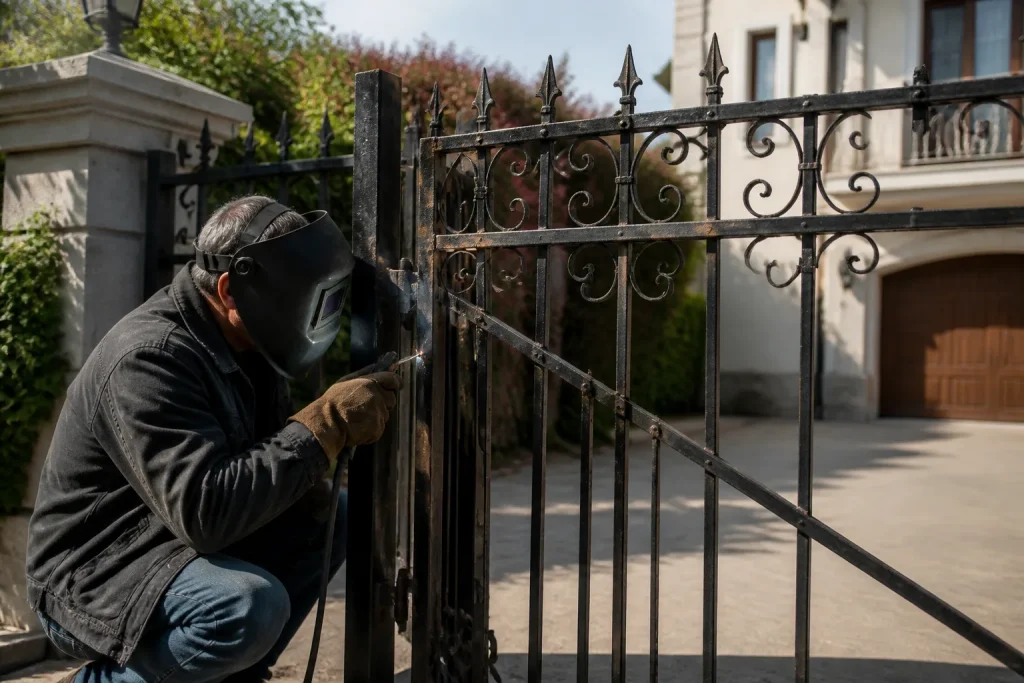
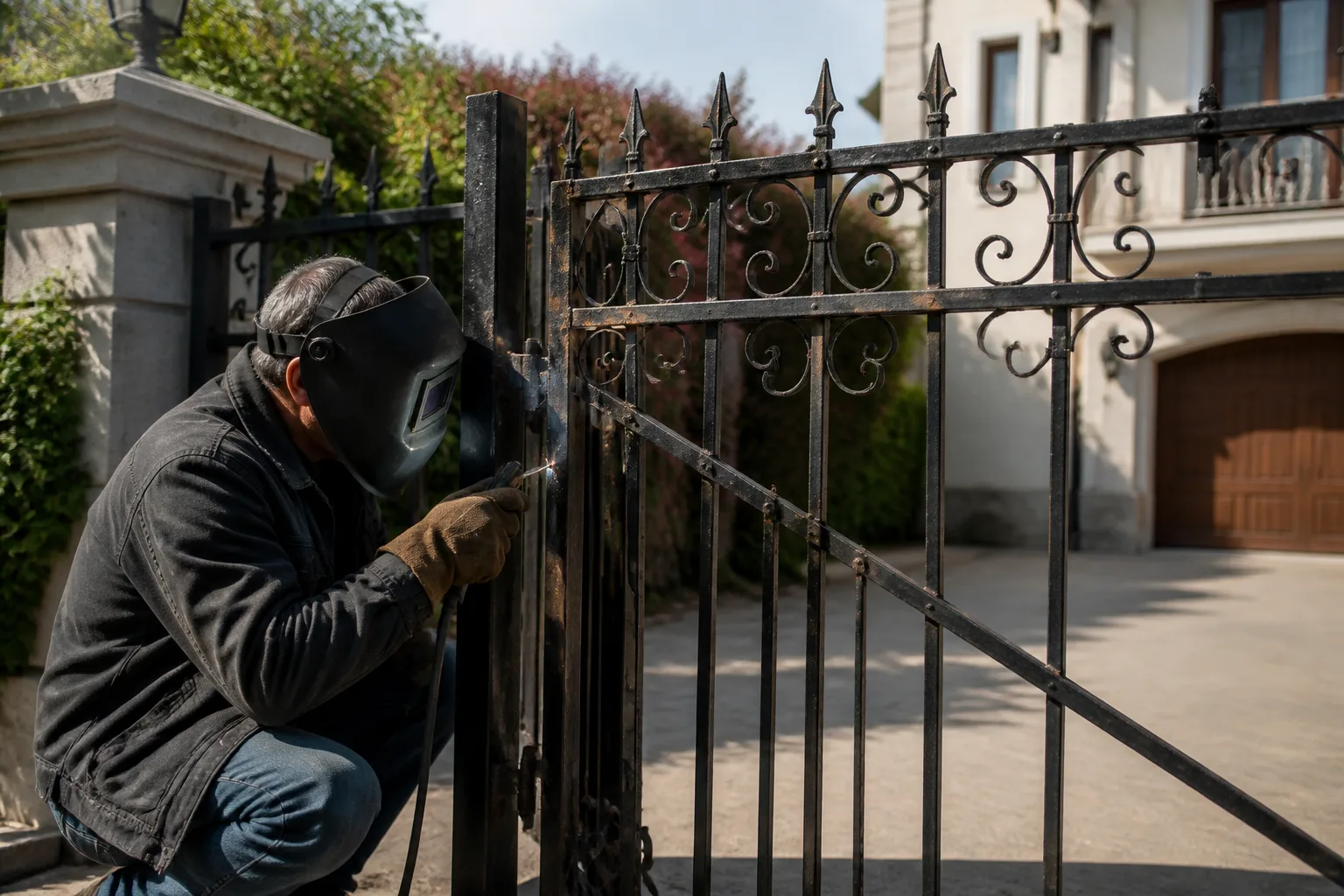
We welded a cracked frame last month on a hillside property in Diamond Heights where two previous companies had quoted full replacement. The issue was a single stress crack at a poorly placed factory weld. Two hours of fabrication work, and that gate has another decade of service ahead of it. The homeowner saved roughly $4,200.
The Three-Point Inspection Every Honest Tech Should Walk You Through
Before anyone quotes you repair or replacement, they should physically check three things in your presence. If they don’t, you’re getting a sales pitch, not an assessment.
Point one: the post footing. We grab the post and apply lateral pressure. Movement at ground level means the concrete footing has cracked or the post base is rotting underground. This isn’t a gate problem — it’s a foundation problem. Repairing the gate while the post wobbles is throwing money away.
Point two: frame square and plumb. We measure diagonal dimensions across the gate frame. A difference of more than half an inch on a standard driveway gate means the frame has racked. Minor racking can be corrected. Severe racking, especially with accompanying twist, often means the frame has yielded past recovery.
Point three: metal thickness at stress points. We use ultrasonic thickness gauges at hinge locations, operator mount points, and any visible crack origins. This is where the “we can just weld it” shops often fail — they fill a crack in metal that’s already too thin to carry load, and it re-opens in six months.
Carlos and his team won’t quote welding on metal below our minimum thickness standard. It’s not because we can’t make it look fixed. It’s because we know it’ll fail under cycling load, and we’d rather tell you the truth upfront than earn a bad review later.
Why San Francisco Hillside Gates Fail Differently
This is the information competitors almost always miss, and it’s critical for San Francisco property owners.
Flat-lot gates cycle primarily in one plane: open and closed, horizontal swing or slide. Hillside gates — common in neighborhoods like Twin Peaks, Clarendon Heights, Forest Hill, and large sections of Pacific Heights — operate under constant lateral stress that flat-lot gates never experience.
Here’s why: when a gate is installed on a slope, gravity creates a persistent side-load even when the gate is stationary. The uphill hinge carries more weight. The frame wants to rack toward the downhill side. Over years of daily cycling, this creates fatigue patterns that look like random cracks but are actually predictable stress concentrations.
We’ve seen Ghost Controls and DoorKing operators fail prematurely on hillside installations not because the motors are defective, but because the mounting brackets were cracking from frame flex that the operator wasn’t designed to absorb. A welder who understands this will fabricate a reinforced mounting plate and relocate stress concentration points. A parts-swapper will sell you a new operator that’ll fail the same way.
The marine layer doesn’t help either. Fog-driven corrosion accelerates at post bases and lower frame members where condensation collects. A gate that looks cosmetically fine from the street can have structural thinning hidden behind decorative scrollwork.
Custom Fabrication vs. Stock Replacement: The Real Cost Math
San Francisco property values change this calculation significantly. A stock aluminum panel gate might cost $2,800–$4,500 installed. Custom fabrication to repair your existing steel gate might run $800–$1,800. But the comparison isn’t always straightforward.
Custom fabrication makes financial sense when:
- Your existing gate matches architectural details elsewhere on the property
- The gate is part of a historic or HOA-controlled design scheme
- Replacement would require permit rework or neighbor negotiations for shared driveways
- The existing gate uses heavier-gauge steel than comparable new products
- You need non-standard dimensions that stock panels don’t cover
Stock replacement becomes the better value when:
- The existing gate has multiple failure modes across frame, infill, and hardware
- You’re upgrading from manual to automated and the existing frame won’t accept modern operator loads
- Corrosion is systemic rather than localized
- Energy efficiency or insurance requirements favor newer materials
We weld, fabricate, and repair on-site, so we’re not philosophically committed to either answer. Last year in the Richmond District, we fabricated a custom hinge assembly for a 1940s wrought iron gate that would have required $6,000 in custom reproduction if replaced. The fabrication repair cost $1,100. Two months later in the Mission, we told a commercial client their aluminum frame was too far gone — replacement saved them from a second service call we’d otherwise have been happy to charge for.
How to Verify Your Welder Is Working to Structural Standards
Not all welding on gates is equal. Cosmetic filling of cracks — what we call “buttering” — looks fine until the gate cycles a few hundred times and the crack re-opens wider than before.
Ask these specific questions:
Are you preheating the base metal? On anything thicker than 1/8 inch, especially cast iron or older wrought steel, preheat prevents brittle heat-affected zones. A welder who says “I don’t need to” is either working on very thin material or doesn’t understand metallurgy.
What’s your penetration strategy at the crack origin? The answer should involve grinding back to sound metal, possibly drilling stop-holes at crack termini, and building up weld in passes rather than one heavy bead. If you get a blank stare, you’re talking to a cosmetic welder.
Do you stress-relieve after welding? For critical hinge and operator mounts, controlled cooling or peening prevents residual stress from creating new failure points. This matters on gates that cycle daily.
We work on the brand you already have — Viking, Elite, or any of the nine major brands we service — but structural welding is where brand knowledge stops mattering and steel knowledge takes over. A LiftMaster operator mounted to a cracked frame will fail regardless of how well we know the control board.
When to call a pro: If your gate has dropped, is making new noises, or shows visible cracks at hinges or frame joints, the damage is probably progressing faster than you think. Structural gate failures tend to accelerate — a small crack becomes a complete separation, often at the most inconvenient moment possible.
Related services in San Francisco: For issues with your gate’s motor or access control system, see our Gate Motor & Opener in San Francisco page. If you’re considering a full replacement, our Gate Installation in San Francisco team handles everything from standard to custom configurations.
The Bottom Line
Repair versus replacement comes down to three factors: the actual condition of your metal, the capability of the person assessing it, and the specific stresses your property puts on the gate. In San Francisco’s hillside neighborhoods, that third factor is often decisive.
We’re not interested in selling you a new gate you don’t need. We’re also not interested in welding metal that’s too far gone and collecting a callback. Carlos and his team have built 17 years of gate-only experience on giving the right answer, even when it’s the less profitable one.
304 customers reviewed us — here’s what they said: a 4.8-star average across verified reviews, with specific mention of honest assessment and structural repairs that lasted.
If you’re in San Francisco and staring at a cracked hinge, a sagging frame, or a gate that’s suddenly harder to open, call (866) 426-1530 for a free structural evaluation. We’ll walk you through the three-point inspection, show you exactly what we’re seeing, and tell you straight whether welding, fabrication, or replacement is the right call for your specific gate.
Frequently Asked Questions
Most structural welding repairs on residential gates in San Francisco range from $400 to $1,800 depending on access, material thickness, and whether custom fabrication is needed. Simple hinge re-welds fall at the lower end; frame reinforcement with new steel insertion runs higher. Call (866) 426-1530 for an exact quote — estimates are free.
Repair is cheaper roughly 70% of the time when the frame metal is still thick enough to weld safely. Replacement becomes the better value when corrosion is widespread, multiple structural points have failed, or you need to upgrade sizing or automation compatibility. The honest answer requires measuring metal thickness and checking frame square — not eyeballing from the driveway.
A general welder can make metal stick together. A gate specialist understands cycling loads, hinge geometry, operator stress transfer, and how San Francisco’s marine corrosion and hillside settling affect long-term performance. We’ve re-repaired gates that “fixed” welders had patched cosmetically, usually at higher total cost than doing it right the first time.
Properly executed structural welding with appropriate base metal thickness lasts 10–20 years under normal cycling. The key variables are preheat protocol, penetration depth, and whether the original failure cause was addressed. We warranty our fabrication work because we control the full process from diagnosis to completion.
Written by Carlos Estrada, Owner & Service Manager at Anchor Gate Repair San Francisco, serving San Francisco since 2009.
Need Gate Repair Help?
Call Anchor Gate Repair San Francisco — licensed & insured, available 24/7 in San Francisco.
(866) 426-1530