5 Mistakes to Avoid With Gate Repair
The most expensive gate repair mistakes aren’t made by homeowners who ignore their gates — they’re made by people trying to be proactive who get bad advice or follow logical-sounding assumptions that backfire. In 17 years of gate-only work across San Francisco, Carlos and his team have seen well-meaning property owners turn $200 fixes into $2,000 replacements. Here are the five errors we correct most often, and what to do instead. If you’d rather skip the troubleshooting, call us at (866) 426-1530 for a free estimate.
Mistake 1: Using WD-40 on Gate Hinges and Rollers
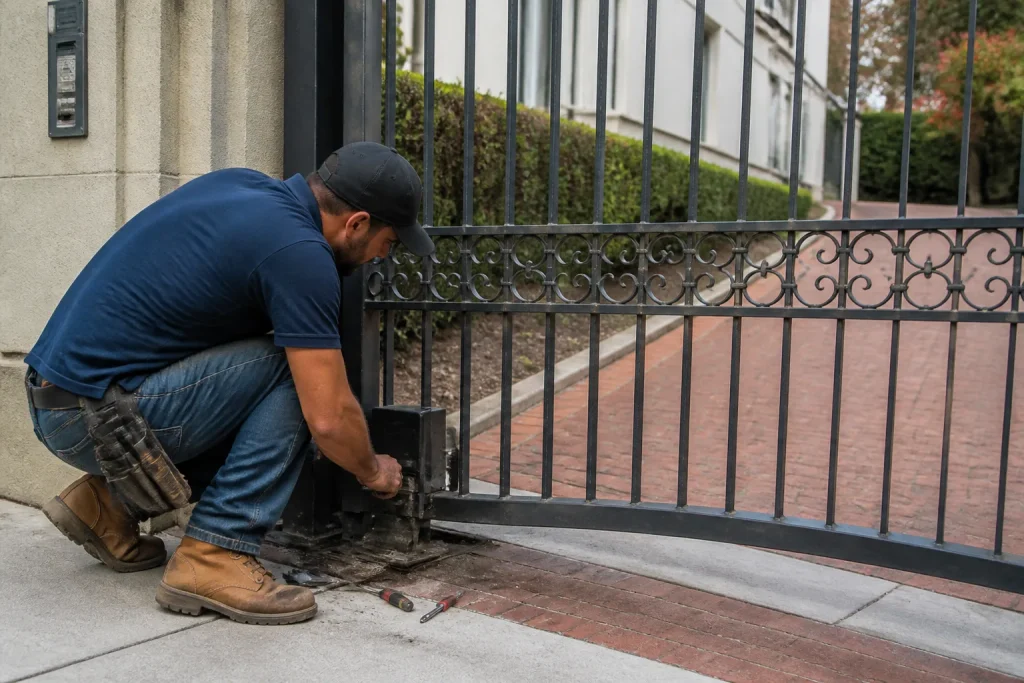
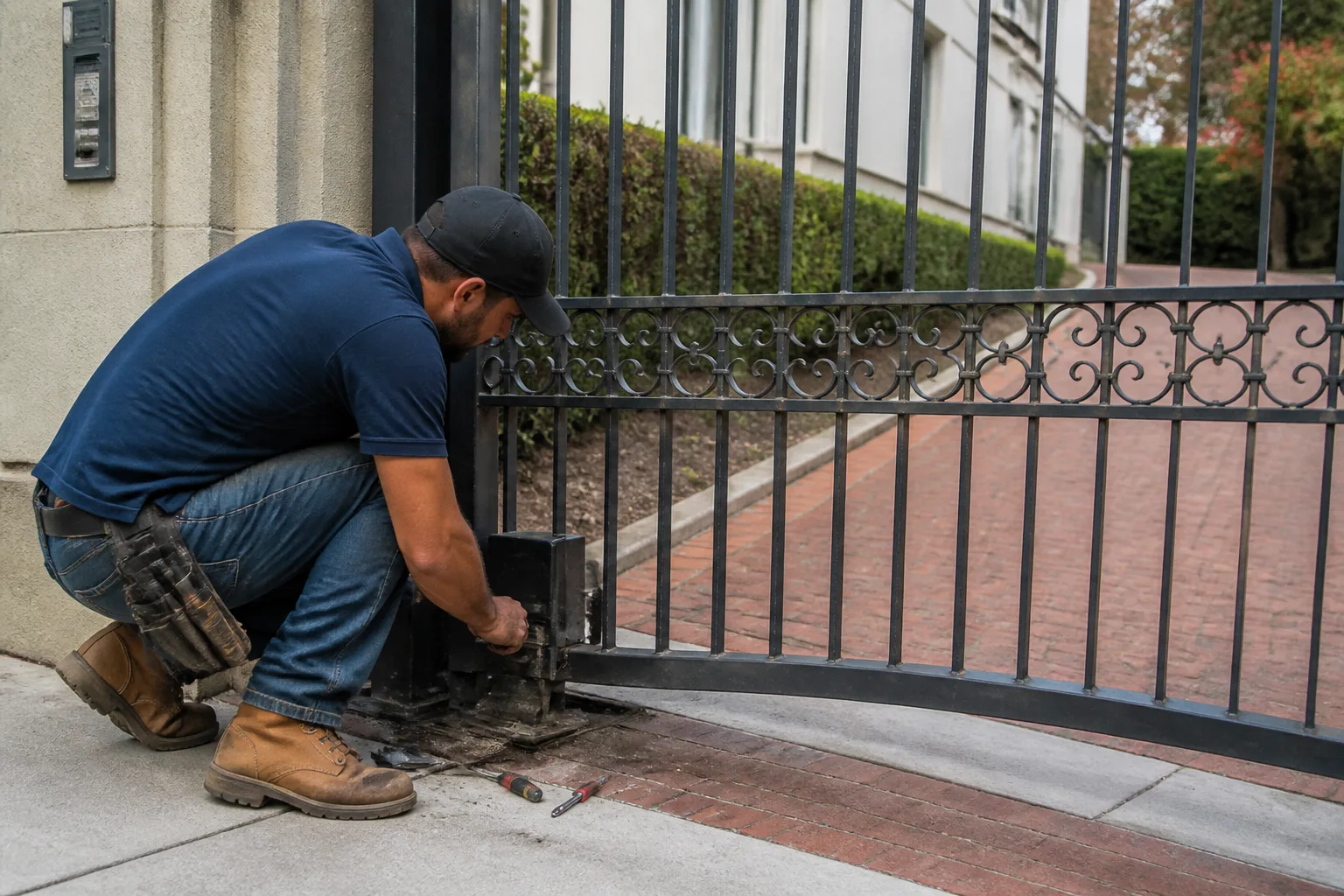
This is the most popular gate maintenance tip online and one of the fastest ways to destroy what you’re trying to fix. WD-40 is a penetrating oil and solvent, not a lubricant. It breaks down existing grease, displaces moisture temporarily, then evaporates — leaving metal-on-metal contact that accelerates wear.
We’ve replaced hinges in the Sunset District that were “maintained” monthly with WD-40 for two years. By the time we opened them up, the bearing surfaces were scored and the pins had ovalized the barrels. The homeowner was genuinely trying to help his gate. He just had the wrong product.
What works instead:
- White lithium grease for hinge barrels and roller bearings — it stays put, handles temperature swings, and doesn’t attract grit like petroleum-based products.
- Silicone spray for nylon or plastic rollers where grease would gum up.
- Manufacturer-specified hinge oil for high-end systems (some Elite and FAAC hardware calls for specific lubricants to maintain warranty coverage).
Apply sparingly, wipe excess, and reapply every 6–12 months depending on San Francisco’s salt air exposure if you’re near the coast.
Mistake 2: Replacing the Motor Without Fixing Why It Failed
A gate motor burns out. You buy a new one. Six months later, the replacement burns out too. This pattern is so common we’ve stopped being surprised by it.
In our experience, roughly 40% of “defective” gate motors we diagnose in San Francisco aren’t defective at all — they’re victims of mechanical problems upstream. A binding hinge, misaligned track, or failing limit switch forces the motor to work harder than designed. The thermal overload eventually trips repeatedly, the windings degrade, and the control board fails. Swap the motor, leave the root cause, and you’ve installed a very expensive fuse.
Before any motor replacement, check:
- Gate travel — does it bind or drag at any point in its arc?
- Track alignment — are rollers walking the rail evenly, or climbing one edge?
- Limit switches — are they set correctly, or is the motor straining against physical stops?
- Power supply — low voltage from undersized wiring causes motors to overamp.
We work on the brand you already have, including Gate Motor & Opener in San Francisco systems from LiftMaster, Mighty Mule, and others. Carlos personally diagnoses these failures before quoting replacement — it’s why our motor jobs don’t come back.
Mistake 3: Treating Low-Voltage Gate Systems as “Safe” DIY Electrical
24 volts won’t shock you. It will absolutely destroy a $400 control board.
Low-voltage gate systems carry enough current to fry sensitive electronics if you short the wrong pair. We’ve seen homeowners in the Mission District replace a “simple” photocell, cross two wires they assumed were interchangeable, and take out the entire logic board plus the transformer. The $35 sensor became a $680 repair.
Beyond the cost, unauthorized electrical work on automated gates can void manufacturer warranties. LiftMaster and FAAC both require certified service for certain board-level repairs to maintain coverage. “But it was only 24V” doesn’t help when you’re holding a denied claim.
What you can safely check yourself:
- Photocell alignment — clean lenses, verify LED indicators match, check for physical obstructions.
- Remote battery — weak transmitters cause erratic behavior that looks like system failure.
- Manual release — verify it functions; this is your backup if automation fails.
Leave board diagnostics, wiring modifications, and safety-edge testing to someone with the right meters and factory training. The control board doesn’t care that you meant well.
Mistake 4: Hiring by Price Alone in San Francisco
San Francisco’s gate repair market has a predictable pattern: low bid wins, shortcut gets taken, structural damage follows, second contractor charges triple to fix both the original problem and the new damage.
We see this most with welding and track work. A handyman with a 110V flux-core welder patches a gate frame for $150. The weld looks fine. Three months later, the gate sags because the heat-affected zone wasn’t normalized, the original stress riser still exists, and now the post footing is cracked from transferred load. We weld, fabricate, and repair on-site with proper 220V MIG/TIG equipment and structural awareness — the same gate, properly fixed the first time, runs $400–$600 but lasts years.
The specific pattern in this city: low-bid operators often lack the in-house capability to diagnose structural issues, so they don’t bid them. They fix the opener, collect payment, and the gate continues destroying itself silently. By the time the owner calls us, we’re looking at post replacement, footing work, or full gate rebuild.
Red flags in a gate repair quote:
- No physical inspection — phone estimates for mechanical problems are guesses.
- No discussion of root cause — if they can’t explain why it failed, they won’t prevent recurrence.
- Brand-specific push — “we only work on X” often means limited diagnostic skill, not expertise.
304 customers reviewed us — here’s what they said. The consistent theme isn’t that we’re cheapest; it’s that the job stays done.
Mistake 5: Delaying Repair on a “Functional but Slow” Gate
A gate that still opens but takes longer than it used to isn’t “getting old.” It’s operating under mechanical stress that compounds exponentially, not linearly.
Here’s the math we explain to property managers: a motor rated for 15 amps draws 15 amps under design load. Add a binding hinge that increases friction by 20%, and current draw doesn’t hit 18 amps — it spikes higher during startup and stall conditions, generating heat that degrades windings. Each cycle makes the next slightly worse. The gate slows further. The motor works harder. Thermal cycling fatigues connections. Eventually something fails catastrophically, usually at the worst possible moment.
We’ve responded to emergency calls in Pacific Heights at 10 PM where a “slow” gate that the owner planned to “deal with next month” seized completely, trapping vehicles inside. The tow truck couldn’t access the garage. The Uber to the airport was $85. The emergency repair was triple what scheduled service would have cost.
Warning signs that “slow” is actually “stressed”:
- Cycle time increased by more than 2 seconds from baseline.
- Motor housing runs hot to touch after normal operation.
- Audible strain during start/stop — grinding, humming, or clicking that wasn’t there before.
- Intermittent stops mid-travel that resolve on second command.
When to call a pro: If your gate behavior has changed in any measurable way, schedule inspection before it fails closed. Carlos and his team handle Gate Repair in San Francisco from routine maintenance through emergency calls.
Related services in San Francisco: If your gate is approaching end of life, explore Gate Installation in San Francisco options — we can assess repair viability honestly and quote replacement only when it makes sense.
The Bottom Line
The worst gate repair mistakes look like smart decisions in the moment. WD-40 seems logical. Replacing the obvious failed part seems efficient. Saving money on the quote seems prudent. Waiting until “it actually breaks” seems patient. In 17 years of gate-only experience, we’ve learned that each of these instincts, unexamined, costs more than getting it right the first time.
Key takeaways:
- Use lithium grease, not penetrating oil, on mechanical gate components.
- Diagnose root cause before replacing motors or electronics.
- Respect low-voltage systems — they can still destroy expensive boards.
- Price-focused hiring in San Francisco often creates secondary structural damage.
- “Slow” gates are stressed gates; mechanical damage accelerates, not creeps.
If you’re in San Francisco and your gate is showing any of these warning signs, Anchor Gate Repair San Francisco home offers free estimates. Carlos Estrada personally oversees service quality, and we work on the brand you already have. Call (866) 426-1530 to schedule.
Frequently Asked Questions
No — it’s worse than nothing for gate hinges and rollers. WD-40 strips existing lubricant and leaves metal unprotected. If you’re in a pinch, pick up white lithium grease at any hardware store in San Francisco before applying anything. Call (866) 426-1530 if you’re unsure what your specific gate needs.
New motors fail fast when they’re replacing a motor that died from mechanical stress, not old age. Binding tracks, misaligned hinges, or incorrect limit switches force the replacement to work just as hard as the original. We diagnose upstream problems before installing any motor — it’s why our jobs last. Call (866) 426-1530 for a proper assessment.
24V systems won’t electrocute you, but a shorted wire can destroy control boards, void warranties, and create fire hazards in the low-voltage transformer. We recommend limiting DIY to photocell cleaning, remote battery replacement, and manual release testing. For anything involving wire nuts, terminal strips, or board connections, use a technician with factory training on your specific brand.
Legitimate gate repair quotes follow physical inspection, explain root cause, and match the scope to your actual equipment. Be wary of phone estimates, brand-restricted service that doesn’t match your installation, or pricing that seems disconnected from the visible problem. 304 customers reviewed us at 4.8 stars — we show up, diagnose properly, and quote what the job actually requires.
Written by Carlos Estrada, Owner & Service Manager at Anchor Gate Repair San Francisco, serving San Francisco since 2009.
Need Gate Repair Help?
Call Anchor Gate Repair San Francisco — licensed & insured, available 24/7 in San Francisco.
(866) 426-1530